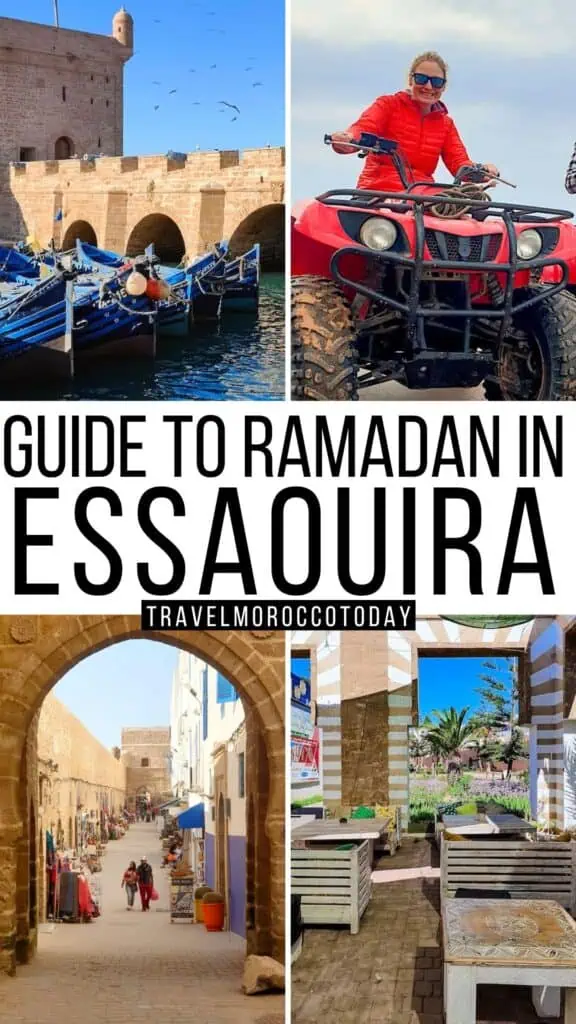
I assume you’re here because you plan to spend at least part of Ramadan in Essaouira. If so then you’re in luck because I think Ramadan is one of the best times to visit Essaouira.
I know you may find that surprising but I really LOVE Essaouira at this time of year. I like that things tend to feel a little bit quieter since some small shops and restaurants close.
I also love that it is the holiest month of the year and that you can see people praying in the streets since the local mosques become packed with people.
Overall, it’s the perfect time to learn about local culture and enjoy Iftar (an evening meal where Muslims break the fast)at one of the best restaurants in Essaouira.
However, do NOT panic about visiting Essaouira during Ramadan. Most restaurants and businesses will remain open since everyone still wants to make money.
Therefore, you will have no problem finding food, enjoying a surf lesson, or booking a hotel. Just plan a bit of flexibility into your itinerary since some places close for renovations as they get ready for the remainder of the year.
Trust me on this. I have experienced many Ramadans in Essaouira – since I have been living here since January 2023 – and I think the only place I truly love that closes is Al Jazira.
So, you should have absolutely no problem finding food or enjoying some of the best things to do in Essaouira. However, if you want to be fully prepared, have a look at this amazing guide.
It will tell you everything you need to know about enjoying Ramadan in this beautiful beach town.
This post may contain affiliate links. Please see my disclosure for more information. As an Amazon Associate, I earn a small commission from qualifying purchases.
Table of Contents
When is Ramadan in Essaouira?

Like everywhere else in the country, Ramadan in Morocco is set to start on the evening of February 28th. The holiday lasts for a full 30 days and will then end on March 29th or on the 1st of April in Marrakech and Essaouira.
So, if you plan to spend March in Marrakech or Essaouira then be aware of this.
Please remember that this is a guess only. The exact dates of the holiday are only determined the night before. Therefore these estimates could be a few days off since the holiday is determined by the appearance of the crescent moon.
The reason for this is that Ramadan is held during the ninth month of the Muslim calendar and does not follow the Gregorian calendar. Therefore, Ramadan is usually 10-12 days earlier than the year before.
What is Ramadan?

As I mentioned before, Ramadan occurs during the ninth month of the Islamic calendar. It is considered the holiest month of the year since this holiday commemorates the moment when the Quran was revealed to the Prophet Muhammad.
For Muslims, Ramadan involves fasting every day from sunrise to sunset. This means refraining from eating, drinking, smoking, and sexual activity during daylight hours.
It’s important to note that fasting practices can vary among individuals. For example, my partner and I abstain from sex for the entire month because he explained that it would invalidate his fast.
We also avoid kissing during the fasting hours. However, these practices may vary from person to person.
Fasting is important because it is one of the Five Pillars of Islam. Therefore, it is a central part of Mulsim worship and a sign of devotion to God.
Overall, Ramadan is a deeply spiritual month focused on prayer, giving to those in need, and helping the poor, as individuals aim to grow closer to God.
Not everyone is required to fast though. Exceptions are made for children under 16, the elderly, those who are sick, women who are menstruating, pregnant, or nursing, and anyone with medical conditions like diabetes.
As a result, my partner’s mom cannot fast due to her diabetes. However, those who can fast typically do so to experience the holiness and beauty of this sacred time of year.
During Ramadan, two meals are especially significant: Suhur and Iftar. Suhur, the pre-dawn meal, is usually eaten around 4:00 am, while Iftar, the meal that breaks the fast, typically takes place after sunset, around 7:00 pm.
In my partner’s family, Iftar often includes traditional Moroccan dishes like msemen, harira, dates, boiled eggs, and chebakia.
These meals are nourishing and designed to sustain you for the day ahead. Many restaurants also serve special Ramadan menus. However, not surprisingly, I prefer dining with my partner’s family since his mom is an amazing cook.
You might also hear canons or sirens (Medfaa) around sunset. They signal the start of Iftar so people know it’s time to break their fast.
Similarly, there’s often a canon or siren before Suhur to wake people up, and another to indicate when Suhur has ended and fasting begins again.
Ramadan concludes with Eid Al-Fitr, a joyous celebration where families gather together to share meals and enjoy the day in Essaouira together.
Traditional Moroccan foods like Beghrir are served, tea is shared, and people dress in traditional clothing to mark the end of this sacred month.
Get Your Amazing 7-Day Morocco Itinerary Now!
Planning a trip to Morocco and not sure where to start? Or, maybe you don’t have weeks to sit and do research to create the perfect Morocco itinerary. If so then I am here to help. I have lived in Morocco with my Moroccan partner for YEARS. I created this custom, 45-page, 7-day itinerary so that you could plan the best trip possible with the least amount of stress. Customers are calling this itinerary “brilliant” and I think you will too. So, get yours now!
Tips for Spending Ramadan in Essaouira
Now that you know what Ramadan is and when Ramadan is, let’s look at some travel tips that you can use to help make your trip to Essaouira better.
Again, I want to repeat that things will be open. So, you should have no problem getting a meal during the day or finding a riad in Essaouira that is open.
Yes, some things will close for the entire month. However, I have found that to be the exception and not the rule. So, basically, if there is a demand for a service then that business will likely be open.
Many places that tend to close do so because there is little to no demand for their services. I mean, it makes no sense to open a restaurant during the day if no one is eating.
So, plan to be flexible and don’t be surprised if a few things are closed. However, most things in Essaouira should be open and should feel like business as usual.
Here are some more travel tips to help you have an amazing time in Essaouira.
- Plan for Flexibility in Your Schedule – Ramadan often means changes to daily routines, especially in rural areas. Smaller shops and restaurants may close for the entire month or operate on modified schedules. Be prepared to adjust your plans and remain flexible.
- The Clocks Will Go Back an Hour – During Ramadan, the clocks will be set back an hour to help make fasting a bit easier. Once Ramadan ends, everything will go back to normal.
- Be Patient with People – Since locals fast from sunrise to sunset, they may become a bit irritable due to hunger and thirst. It’s important to be patient and understanding. Fasting all day is challenging, and feeling “hangry” is natural. However, as the month progresses, people generally adjust to their new routine.
- Respect the Holiest Month of the Year – Ramadan is the holiest month of the year for Muslims, so act accordingly. Personally, I avoid eating or drinking in front of my boyfriend while he’s fasting, refrain from alcohol, and dress more conservatively. While no one will yell at you for drinking water or eating in public, be mindful of those fasting around you and try not to eat/drink in public. It is also wise to avoid public displays of affection while walking down the street.
- Alcohol Will Be Available – Restaurants and hotels do sell alcohol during Ramadan, although Muslims are not legally allowed to buy it throughout the month. In contrast, alcohol stores in the city will be closed all month long. Personally, I would avoid drinking alcohol in Essaouira throughout the month since this is a holy time and alcohol is very taboo for Muslima.
- Do Not Go Food Shopping Right Before Sunset – Basically, local stores will be packed with people since everyone is getting food and drinks right before they head home for Iftar. So, avoid shopping in Essaouira at this time of day since you’ll encounter long queues of people.
- Avoid Making Plans Between 7:00 pm and 9:00 pm – At sunset, people break their fast and go home to eat with their families. During this time, businesses may temporarily close, and hotel staff or restaurant workers might step away to have Iftar. Most people won’t resume work or activities until around 9:00 pm. This happened to me when I was staying in the Agafay Desert and staff are usually only gone for about an hour.
- Don’t Expect an Early Start to the Day – Since many Moroccans wake up before dawn for Suhur (the pre-fast meal), they often sleep in to conserve energy during the day. As a result, don’t expect much to open before 11:00 am. However, major hotels, restaurants, and tourist attractions will generally stick to their normal schedules.
- Avoid Traveling on Eid Al-Fitr – Eid Al-Fitr marks the end of Ramadan and is a time for family celebrations and feasting. Many businesses close on this holiday and transportation may be limited. So, I would try to avoid traveling on this holiday.
- Dress Conservatively – Women should keep their knees, and shoulders covered during Ramadan. This is the holiest month of the year and it is not appropriate to wear revealing clothing. At other times of the year, you can probably get away with wearing slightly more revealing attire. However, not during Ramadan. For more info, check out my guide on what to wear in Essaouira. Women also do not need to wear a hijab.
Get Your Amazing Morocco Safety Guide Today!
Planning a trip to Morocco and worried about safety? Or, maybe you don’t have time to scour the internet for mediocre safety tips from someone who has been to Morocco once. If so then let me help. I live in Morocco with my Moroccan partner and have developed these safety tips after spending years traveling in Morocco alone. I created this custom, 26-page document with 19 actionable tips to help you stay safe and have the best time possible. Get yours now and take the anxiety out of traveling to Morocco.
Conclusion
I hope you feel a lot better about traveling to Essaouira during Ramadan and understand that things will 100% be open.
Personally, I think it is a great time to visit the city. Not only will you get to learn about local culture, but you also won’t have to deal with noisy construction since it stops during the holiday.
Plus, you’ll get to enjoy amazing local food if you order from a restaurant’s special Iftar menu. TBH, I love the food that is served for Iftar and think this is a mjor reason to experience Ramadan in Essaouira.
If you enjoyed this post, sign up for our email list and Facebook group for even more awesome Morocco travel tips.
Finally, please consider buying me a coffee. It’s a great way to say “thank you” for all the free content you receive. No amount is too small and anything you can give will be greatly appreciated.