
If you’re planning a trip to Morocco or have been to Morocco then you’ve probably heard of the blue city, Chefchaouen. But, the question on everyone’s mind is, why is Chefchaouen blue?
Well, I hate to be the bearer of bad news, but there is no definitive answer as to why the Majorelle blue homes of the Medina are that color.
There is a lot of speculation and a lot of theories as to why Chefchaouen is painted blue, but no one really knows for sure.
I even asked locals the past couple of times that I visited and no one really had an answer.
So, if the locals don’t know then it’s a solid bet that no one else does either. However, let’s look into several theories that have emerged as to why the blue city in Morocco is blue.
This post may contain affiliate links. Please see my disclosure for more information. As an Amazon Associate, I earn a small commission from qualifying purchases.
Table of Contents
Why is the Blue City Painted Blue? My Top Pick

No one knows for sure where Chefchaouen got its blue color from.
But, what’s pretty clear is that the homes of the Medina are probably repainted blue twice a year for tourism.
That’s right! The beauty and unique blue color of this town is one of the reasons why Chefchaouen is worth visiting.
I mean, just walk around the Medina and you’ll find riads, vendors selling souvenirs, and people charging you 10 or 20 Dirham to take a photo on a really cool street.
All those things generate a lot of money for locals from tourists. So, I kind of get why they want to keep the blue city blue.
Other Theories on Why is Chefchaouen Blue?
Well, to figure out why Chefchaouen is blue, we first need to figure out when Chefchaouen started being painted blue. This way we can figure out which theory makes the most sense.
So, let’s swan dive into a little history about when the blue city became the blue city.
History of Chefchaouen and When it Became Blue
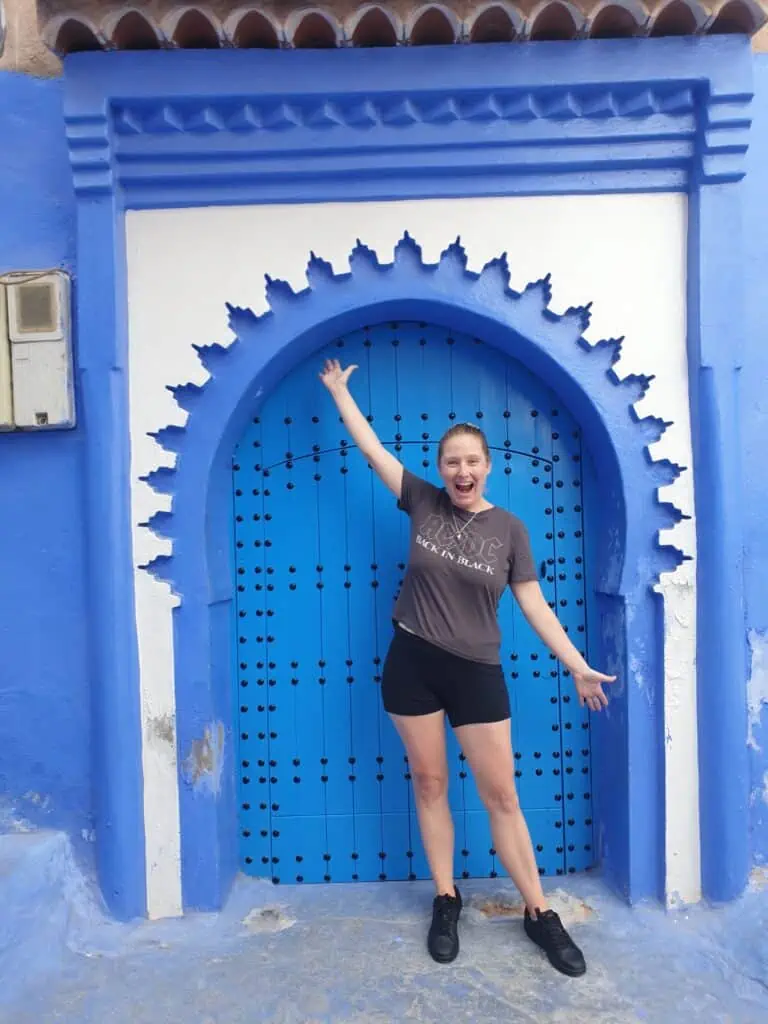
Chefchaouen started as the direct result of an attack by Portuguese forces that led to the founding of the city in 1471.
Essentially, the fortress started to grow and the city expanded beacause the Ghoramas (northern Moroccan tribes) wanted safety and protection from invading forces.
Other people also settled here, like Moriscos (a Muslim group) and Jews from Spain/Portugal who wanted to flee the Spanish Inquisition.
Eventually, the threat from Portuguese forces dissipated and a Medina emerged around the fortress.
The city steadily grew due to its excellent location along the Fez-Tetouan trade route, with more and more Jews and Muslims seeking refuge here.
Sadly, because of increased threats from the Portuguese, the city was totally closed to Christians and Europeans of any kind, until around the early 1900s.
In fact, historic records indicate that only three travelers of European descent were able to enter the city at this time in history.
FYI, this is important because it will help us understand when the city turned blue.
These travelers were French explorer Charles Foucauld, who entered the city in 1883 when he convinced residents he was a rabbi.
Walter Harris was an English journalist who got access to the town in 1889 when he pretended to be a Moorish merchant from Fes.
He basically rode a donkey here from Tangier since it was otherwise impossible for Christians to visit.
The last was a good old fashioned missionary by the name of William Summer who actually entered the town and was then poisoned to death.
None of these people ever mentioned the town being blue in historic records. Therefore, it is unlikely that the blue color dates back for centuries.
Instead, reports of a blue city emerged in the 1920s when the city was conquered by the Spanish, and anyone could visit.
So, whatever event or reason for this blue color started around this time.

Book Your Morocco Travel Consultation Now!
Nervous about traveling to Morocco and are not sure where to start when it comes to planning your tour?
Want to see the country from the local perspective?
Have an itinerary planned but aren’t sure if it needs any tweaks?
Don’t worry! I have you covered! Book a private consultation now and let me help you plan your trip. These one on one calls are designed to tailor your itinerary according to your personal preferences and needs!
To Keep the Mosquitoes Away
Some people theorize that the blue color keeps the mosquitoes away and that’s why people started painting their houses blue.
I dunno. This theory seems a bit odd to me since half the city is not blue. Plus, many scientific journals state that color alone, without the presence of carbon dioxide, has little impact on mosquito presence.
That being said, the many times I’ve been in Chefchaouen I can’t remember getting a mosquito bite. So, you never know.
To Represent Water

Some people claim that the walls of Chefchaouen were painted blue to represent water and the
Mediterranean Sea,
Other locals state that the blue water is really meant to symbolize Ras el-Maa Waterfall and how important it is in the city since this is where people got their drinking water.
I guess this theory rests on the idea that water gives people life and is such an important resource that people want to honor it by painting their houses blue.
I dunno, this doesn’t really make sense to me. Marrakech is in a desert and there is a lot less water. Why aren’t those homes blue?
Plus, Achour is right down the road and there is water everywhere that I am sure people could have used.
It’s definitely possible but it just doesn’t strike me as the most probable theory.
To Keep the Town Cool

Well, it’s no secret that Chefchaouen is hot, especially in the summer when highs soar to 32°C (90°F) and you’re sweating to death as you hike through Chehchaouen to the Spanish Mosque.
So, if you’re not sure how long to stay in Chefchaouen in the summer, get your pics and run (j/k)!
Anyway, I don’t think this is the answer either. Firstly, Chefchaouen has always been hot. So, why all of the sudden start painting the town blue in the 1920s?
Secondly, the Allstate website clearly states that, “dark, dull colors can absorb 70 to 90 percent of the sun’s radiant energy.”
So, if that’s the case, wouldn’t a blue color increase the temperature of the home due to increased absorption of ambient light?
I guess it really just depends on your definition of “dark” and “dull” colors. But, I am just not buying this theory either.
Planning 7 Days in Morocco? Start Here.
Skip the hours of research and guesswork. I created this 45-page, step-by-step Morocco itinerary based on my years of living and traveling in Morocco. It lays out where to go, what to see, and how to make the most of a 7-day trip, without spending weeks planning it yourself. Get the practical itinerary I wish every first-time Morocco traveler had.
To Look Nice and Create a Soothing Environment
If you ask some people in town why the city is blue they’ll say that it’s a nice, attractive color that is just there to calm people down.
Plus, in Islamic culture, blue is actually a color that is associated with optimism and happiness.
This could very well be since Morocco is a very community based society. So, perhaps some people started this trend and then the color eventually spread all throughout the Medina.
For Religious Reasons When the Jews Fled Here from Nazi Germany

If I had to guess why is Chefchaouen blue, this would be my best guess. First of all, the timing adds up.
If the blue color began in the 1920s then this is around the same time that Jews would have started to flee Germany as a result of Nazi persecution.
Sure, the Nazis weren’t in power, but WW I ended in 1918 and shortly after, Germans started to look for someone to blame for all of their economic problems.
Jews eventually became the scapegoat and anti-semitism started to rise.
Hilter would later publish his book, Mein Kampf, and I am sure a few people read that and decided to leave as a result.
I know my own great grandfather read that book and decided to flee with his family to America since he thought Hitler was “nuts”.
My family also had an aunt who suddenly “disappeared” and was never heard from again – something that I am sure was more than a little unsettling for my ancestors.
So, I doubt my family was the only family to flee Germany in the 1920s – and I’m not even Jewish!
So, if Jews did flee to Chefchaouen in the 1920s, why did they start to paint their homes blue?
Apparently, the blue color was part of a religious practice. The floors, steps, and walls of homes were painted blue to represent the sky and to connect people with heaven and God above.
Do I know this for certain? No, of course not, But, this is my best guess. And it’s fun to try and figure this out as you explore the top landmarks in Chefchaouen.
It’s also worth noting that many other parts of the Medina didn’t really “turn blue” until around 40 years ago. That probably all had to do with tourism, as I alluded to at the start of this post.
Want to Feel Confident Traveling in Morocco?
Get the practical safety advice I wish every first-time visitor had before their trip. I’ve lived in Morocco since 2023 and have spent years traveling around the country. I created this 26-page Morocco Safety Guide to give you practical, realistic advice for navigating Morocco confidently—from avoiding common tourist scams to knowing what to expect and how to handle situations that can catch first-time visitors off guard. No fear-mongering. No generic advice from someone who spent a week in Marrakech. Just practical tips from someone who actually lives here.
Why is Chefchaouen Blue FAQs
When Did Chefchaouen Become Blue?
Chefchaouen became blue in the 1900s and around the 1920s more specifically when the town was opened up to outsiders by the Spanish.
Why is Everything in Morocco Blue? What Does Blue Mean in Morocco?
Things in Morocco are blue because it symbolizes the infinite, tranquility and peace of mind.
Are There Still Jews in Chefchaouen?
The city has a population of 50,000 and there are currently no more Jews in Chefchaouen.
What is a Fun Fact About Chefchaouen?
A fun fact about Chefchaouen is that the town is named for the blue color on the ancient medina walls.
That wraps up this guide about why Chefchaouen is blue. I hope you found it fun and interesting and are excited to do a cool day trip to Chefechaoen from Fes or maybe a day trip from Tangier.
If you found this post useful, join our email list and Facebook group for even more awesome Morocco travel tips.
Finally, please consider buying me a coffee. It’s a great way to say “thank you” for all the free content you receive. No amount is too small and anything you can give will be greatly appreciated.