
Knowing what not to do in Marrakech is just as important as knowing what to see. This is an incredible city, but there are a few mistakes that can make your trip more stressful, expensive, or frustrating than it needs to be.
I’ve been living in Morocco since 2023 and have spent plenty of time exploring Marrakech. And trust me, I’ve made some mistakes along the way!
When I first arrived, I got overcharged by taxi drivers left and right. It took me a while to figure out how to handle taxis, navigate the Medina, and avoid some of the more annoying tourist traps.
I’ve also had vendors get angry when I didn’t want to buy something, discovered attractions that I thought were overrated, and learned a few things about local customs through experience.
So, I’ve put together 23 things not to do in Marrakech to help you avoid the mistakes I’ve made and make the most of your trip.
From taxi scams and shopping in the souks to choosing attractions and understanding Moroccan culture, here’s what I wish I’d known before my first visit. Let’s get into it!
This post may contain affiliate links. Please see my disclosure for more information. As an Amazon Associate, I earn a small commission from qualifying purchases.
Quick Guide: What Not to Do in Marrakech
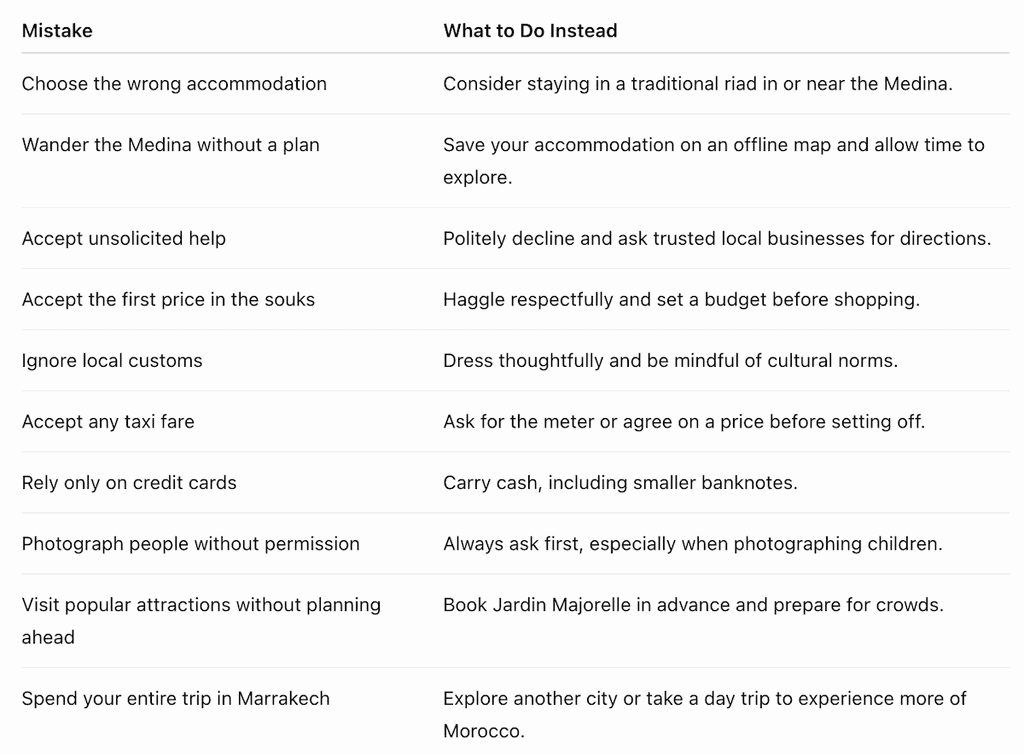
Table of Contents
1. Don’t Book a Hotel Without Considering a Riad

When planning a trip to Marrakech, you might be inclined to book a conventional hotel. But before you do, consider staying in a traditional Moroccan riad instead.
Riads are traditional Moroccan homes or palaces built around an interior courtyard, often with a garden, intricate tilework, and several floors of rooms overlooking the central space. Many also have beautiful plunge pools, rooftop terraces, and on-site restaurants or hammams.
Historically, riads were the residences of affluent merchants and officials. Today, many have been converted into boutique hotels, offering a much more intimate experience than a conventional hotel.
One of my favorite things about staying in a riad is having somewhere peaceful to retreat to after a busy day exploring the Medina.
You can spend hours wandering through the souks and dealing with the crowds, then return to a beautiful courtyard where everything feels calm.
I stayed at Riad Palais Sebban the last time I spent 48 hours in Marrakech, and absolutely loved it.
The property was once an 18th-century palace and has been converted into a stunning hotel. It features a gorgeous tiled courtyard, an outdoor pool, colorful rooms, and a private balcony overlooking the central courtyard.
The staff was friendly, and the location in the Medina made it a great option for mid-range travelers.
Don’t forget to check out the on-site restaurant and hammam before you leave!
My tip: You don’t necessarily need to avoid conventional hotels. If you want resort-style facilities, elevators, or a larger swimming pool, a hotel might suit you better.
But if you want beautiful Moroccan architecture and a more intimate stay, I’d seriously consider booking a riad.
2. Don’t Stay Too Far Outside the Medina

Staying inside the Medina can be annoying. It’s loud, the streets can be confusing, and you’ll probably get lost trying to find your riad at least once. 😂
Additionally, many tour operators and taxi drivers won’t be able to drop you off right at your accommodation because much of the Medina is pedestrianized, and many streets aren’t accessible by car.
But honestly, I still think staying in or near the Medina is worth it for most first-time visitors.
You’ll be close to many of Marrakech’s main attractions, including the souks, Bahia Palace, and Jemaa el-Fna. You’ll also have plenty of restaurants, cafes, and breakfast spots within walking distance.
Plus, the Medina is incredibly atmospheric. Wandering through its narrow streets, discovering hidden courtyards, and watching everyday life unfold can feel like stepping back in time.
Staying farther away in areas like Gueliz can be a great choice if you prefer a more modern neighborhood, quieter streets, or easier access by car. However, you’ll need to factor in additional walks and taxi rides to reach main sights.
My tip: If it’s your first time in Marrakech and you only have two or three days, I’d choose accommodation in the Medina or within easy walking distance of it.
Just check the exact location before booking, since some riads are much harder to reach with luggage than others.
3. Don’t Assume the Tap Water Will Agree With You
Personally, I haven’t had a problem with the tap water in Morocco. I drink it, use it to brush my teeth, and have had zero stomach issues.
But I live here and have had time to get used to the local water. If you’re visiting Marrakech, I’d be more cautious, especially if you have a sensitive stomach and don’t want to spend your vacation in the bathroom. 😂
For most travelers, sticking to sealed bottled water or water that has been properly treated is the safer option. If you’re unsure about the water at your accommodation, just ask your host.
Want to reduce plastic waste while traveling? Consider bringing a reusable water bottle with a filter or purifier that’s specifically rated to remove the microorganisms of concern.
I typically travel with a LifeStraw because it takes up minimal room and is easy to pack.
Just remember that not all filters remove viruses or every type of contaminant, so check what your particular bottle can actually treat before relying on it.
My tip: Stay hydrated, especially when you’re walking around Marrakech in the heat. And if you develop stomach issues, don’t automatically assume the water is to blame because food and other exposures can also be responsible.
Planning 7 Days in Morocco? Start Here.
Skip the hours of research and guesswork. I created this 45-page, step-by-step Morocco itinerary based on my years of living and traveling in Morocco. It lays out where to go, what to see, and how to make the most of a 7-day trip, without spending weeks planning it yourself. Get the practical itinerary I wish every first-time Morocco traveler had.
4. Don’t Wander Into Quiet Medina Alleys Late at Night

Marrakech’s Medina is a completely different place after dark. As the evening progresses, many souk shops close, some smaller streets become quieter, and navigating the maze of alleys can get a lot more complicated.
One thing to keep in mind is that a route you used to get back to your riad in the morning might be closed off or much harder to navigate at night.
And once the crowds thin out, some of the narrower streets can feel surprisingly dark and deserted.
I’ve been hassled by men while walking around the Medina with a friend at night. Nothing terrible happened, and I didn’t feel unsafe, but it was annoying enough that I’d rather avoid wandering around unfamiliar, empty alleys late at night.
That doesn’t mean you need to be back at your riad by 9 PM every evening. Jemaa el-Fna and many busy areas remain lively after dark, and you can absolutely enjoy dinner or an evening out in Marrakech.
Just be sure to figure out how you’re gonna get back to your riad before you decide to stay out late.
My tip: If you’re returning to your riad late, save the location on your phone, ask your host which route is best after dark, and stick to well-lit, busier streets where possible.
If you’re unsure about walking back, arrange a taxi to the nearest accessible drop-off point. And don’t follow strangers offering to show you a shortcut.
5. Don’t Overplan Your Visit to the Medina

The Medina is basically a giant labyrinth of pedestrianized streets filled with delicious restaurants, boisterous vendors, fragrant spices, vibrant lanterns, and so much more.
Dating back to the 11th century, the historic Medina is surrounded by approximately 16 kilometers of ancient walls and gates.
It’s incredibly easy to get lost here. There are few obvious landmarks, street signs can be small or hard to spot, and the layout of the streets can feel pretty random when you’re trying to find your way around.
But honestly, this is part of the fun!
Some of my favorite things about exploring Marrakech are stumbling across hidden courtyards, discovering little shops I didn’t know existed, and finding places that aren’t listed in every guidebook.
If you plan every stop down to the minute, you’ll miss some of that magic. Leave yourself time to wander, browse the Marrakech souks, stop for mint tea, and see where the streets take you.
You can even do this in Gueliz, where wandering around can lead you to cool independent shops, cafes, and some seriously good brunch spots.
My tip: Wander, but don’t rely on luck when you need to get somewhere specific. Save your accommodation and important destinations on Google Maps, download an offline map, and allow extra time to find your way.
Getting a little lost can be fun; missing your dinner reservation because you can’t find the restaurant is less so. 😂
6. Don’t Accept Unsolicited Help or Directions from Strangers
On the whole, I’ve found Moroccan people to be incredibly friendly and generous. I’ve met people who would literally give you the shirt off their back and then ask if you need anything else.
However, you do need to be careful about unsolicited help in the Marrakech Medina.
Unfortunately, some people who approach tourists offering directions or advice aren’t doing it out of the goodness of their hearts.
They might tell you that a street is closed, claim a particular attraction is inaccessible, or offer to show you the way when you haven’t even asked for help.
If you accept, they might lead you to a shop where you’ll be pressured to buy something. Or they may walk you to your destination and then demand an unreasonable amount of money for their services.
It’s frustrating, especially when you’re genuinely just trying to find your way around.
My advice? If someone approaches you out of the blue offering directions, politely decline and keep walking. If you need help, ask your riad host, a restaurant employee, or someone working at an established business instead.
My tip: You don’t need to be rude or suspicious of everyone you meet. Just remember that unsolicited help isn’t always free, and you can say no without feeling guilty. If you do want a guide, agree on the price before setting off.
7. Don’t Be Afraid to Speak Up

As you walk around the souks of the Medina, you’ll probably notice that some vendors can be pretty pushy when it comes to getting tourists to buy things.
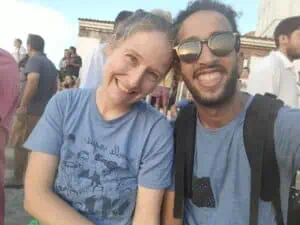
This definitely happened to my partner and me while shopping in the Medina. I was trying on a pair of pants but didn’t like the quality, so I took them off and put them back.
Then the vendor started yelling at my boyfriend, insisting that I buy the pants because he was insulted that I didn’t like them. My boyfriend, who is Moroccan, simply said, “No, thank you,” and walked away.
And honestly? That’s exactly what you should do.
You don’t owe anyone a purchase just because you’ve looked at something, tried it on, or spent time in their shop.
If you don’t like the quality or the price, you’re perfectly entitled to walk away. You shouldn’t feel pressured into buying something you don’t want.
It can feel uncomfortable when someone gets aggressive or tries to make you feel guilty, but you don’t need to argue or justify your decision. A firm “No, thank you” and walking away is usually enough.
You may also want to wait before buying everything on your shopping list in Marrakech. Depending on what you’re looking for, smaller cities like Essaouira can have different options, better prices, and amazing quality.
My tip: If you’re shopping for something expensive, compare the price at a few shops before committing.
And remember, haggling is part of the experience, but you should never feel obligated to buy something just because you’ve negotiated a price.
Oh, and if anyone is ever threatening, just say the word “police” loudly. Secret police in plain clothes wander around the souks, and if they hear you, they will be happy to assist you.
8. Don’t Take Photos With Snake Charmers or Monkey Handlers
When visiting Marrakech, Jemaa el-Fna is a must-see. However, you’ll likely encounter snake charmers and monkey handlers in the square, displaying animals and inviting tourists to pose for photos in exchange for money.
Although these encounters might seem harmless, they raise serious animal-welfare concerns.
Barbary macaques are an endangered species, and the demand for tourist photo opportunities contributes to the exploitation of these animals.
Young macaques may be taken from the wild, separated from their mothers, and kept in stressful conditions so they can be handled by tourists.
Snakes used in tourist performances can also experience stress and poor treatment. Just because an encounter is part of a long-standing tourist tradition doesn’t automatically make it ethical.
And here’s the thing: every time you pay for a photo, you’re helping create demand for these animal encounters. If tourists stop paying, there’s less financial incentive to keep using animals as photo props.
I know it can be difficult to distinguish ethical wildlife tourism from exploitative experiences, especially when you’re traveling somewhere new.
But a good rule of thumb is to avoid tourist attractions that involve touching, holding, feeding, or posing for photos with wild animals.
You can still enjoy Jemaa el-Fna without participating in these encounters. Explore the square, watch the food stalls come alive in the evening, listen to the musicians, and soak up the atmosphere instead.
My tip: If you want to photograph the square, focus on its architecture, food stalls, performers, and bustling street life. Always ask permission before taking close-up photos of people, too.
9. Don’t Accept the First Price Offered to You in the Medina

If you’re exploring the souks and see something you like, one of the things not to do in Marrakech is accept the first price offered without negotiating.
In many shops in the souks, the initial price is open to negotiation, and vendors may start high, especially when selling to tourists who aren’t familiar with local prices.
Haggling is a normal part of shopping in Morocco, and negotiating can be half the fun!
When I haggle, I generally start at around 70% of the price the vendor initially offers and work my way up from there. TBH, though, I usually let my boyfriend handle this. 😂
He loves haggling, and because he was born in Morocco, he often gets a much better price than I do. He also gets genuinely excited whenever he scores a good deal on something!
That said, not every price in Marrakech is negotiable. Restaurants, supermarkets, chain stores, and many boutiques have fixed prices. So, don’t feel like you need to negotiate everywhere you go.
My tip: Decide what you’re comfortable paying before you start negotiating, and don’t be afraid to walk away if you can’t agree on a price.
You can always look elsewhere, and you shouldn’t feel pressured to buy something just because you’ve spent time haggling over it.

Book Your Morocco Travel Consultation Now!
Nervous about traveling to Morocco and are not sure where to start when it comes to planning your tour?
Want to see the country from the local perspective?
Have an itinerary planned but aren’t sure if it needs any tweaks?
Don’t worry! I have you covered! Book a private consultation now and let me help you plan your trip. These one on one calls are designed to tailor your itinerary according to your personal preferences and needs!
10. Don’t Forget to Learn About Local Customs

Whenever you’re visiting a new country, it’s important to learn about local customs and respect the local culture. Morocco is no exception.
For example, modest clothing is generally appreciated in Morocco. As a visitor, I’d recommend packing clothes that cover your shoulders and knees, particularly when visiting religious sites or smaller, more conservative communities.
That said, my personal experience is that people in Marrakech are generally much more relaxed about what tourists wear than some travel guides make it sound.
I naturally dress fairly modestly, but I’ve worn biker shorts throughout Morocco and only had an issue once, in a small village outside Fes.
Other than that, no one really seemed to care what I wore. I even visited my Moroccan partner’s family wearing my usual clothes, and nobody had an issue with my wardrobe. I generally wear longer pants or shorts and T-shirts, though.
Of course, there’s a difference between wearing biker shorts and walking around in extremely revealing clothing.
Crop tops, very short shorts, and low-cut tops may attract unwanted attention in some settings, so use your judgment and dress according to where you’re going.
Another custom worth knowing about is eating with your hands.
Moroccans traditionally eat certain dishes, such as tagine served with bread, using their hands. But don’t worry if you’re not used to doing this! You’re not expected to abandon cutlery just because you’re in Morocco.
I visit my partner’s parents regularly, and they always offer me utensils in case I want them. They have never considered me rude for eating with silverware.
These days, I’ve actually gotten used to eating with my hands, but it took time, and nobody expected me to do it from the beginning.
My tip: Pay attention to the people around you, be respectful when visiting someone’s home, and don’t assume every custom is a strict rule.
Moroccans know visitors come from different backgrounds, and you can show respect for the culture without feeling like you have to get everything right all the time.
11. Don’t Go Overboard With Public Displays of Affection

Moroccans are VERY loving people, but not necessarily when it comes to public displays of affection. 😂
You’ll regularly see friends hugging, holding hands, or putting their arms around each other. But kissing passionately or making out with your partner in public is generally frowned upon, particularly in more conservative settings.
I’ve lived in Morocco since 2023, and I personally don’t kiss my partner in public. We’re perfectly comfortable holding hands or putting our arms around each other, though.
That said, attitudes can vary depending on where you are and the people around you. I once experienced this firsthand at a restaurant in Tangier, where the owner was actually offended when I put my arm around my boyfriend!
It was a good reminder that what’s considered acceptable can differ from one person or setting to another, even within the same country.
My tip: If you’re visiting Morocco as a couple, keep passionate kissing and intimate displays of affection private. Holding hands is generally less likely to attract attention, but when in doubt, take your cues from the people around you.
12. Don’t Eat or Drink Openly in Public During Ramadan
If you’re visiting Marrakech during Ramadan, one of the most important things to remember is that daily life changes quite a bit during this holy month.
Muslims fast from dawn until sunset, which means they abstain from food and drink during daylight hours. Ramadan is an important time for prayer, reflection, family, and community, so it’s worth being mindful of the people around you.
As a tourist, you’re not expected to observe the fast yourself. However, it’s considerate to avoid eating, drinking, or smoking conspicuously in public during daylight hours, particularly in quieter residential areas.
You can generally still find places to eat, especially in tourist areas, hotels, and establishments catering to visitors, although opening hours and availability may differ from the rest of the year.
And once the sun sets, Marrakech comes alive in a different way. Families gather to break their fast with iftar, restaurants become busier, and the city develops a wonderful evening atmosphere.
My tip: If you’re visiting during Ramadan, check restaurant opening hours ahead of time, carry water for when you need it, and be discreet when eating or drinking outdoors.
You don’t need to fast yourself, but you do need to be respectful of the people who are. Ramadan can actually be a fascinating time to visit Morocco, so don’t let the change in routine put you off visiting.
TBH, it’s one of my favorite times to be in the country, and I am always a little sad when people avoid it because it really is a magical time of year.
13. Don’t Accept Whatever Price a Taxi Driver Quotes You

Taxi drivers in Marrakech can be HUGE scammers. They try to overcharge my Moroccan partner all the time, and he’s literally like, “WTH, I live here!” 😂
So, one of the biggest mistakes you can make in Marrakech is accepting the first price a taxi driver quotes you without questioning it.
Instead, ask your hotel or riad what a typical fare should be for your journey. For petit taxis, ask the driver to use the meter (compteur) before you get in.
If the driver refuses, you can try mentioning the police. In my experience, this sometimes gets them to turn on the meter pretty quickly.
If they still refuse, though, I’d simply find another taxi or just agree on the rate before you get in and forget the meter altogether.
Another thing I’d recommend is keeping Google Maps open and following your route as you go. This doesn’t mean every driver who takes a different road is trying to scam you—traffic and road closures are real—but it’s worth paying attention.
We’ve actually had a driver take us on a ridiculously long route for what should have been a 10-minute journey.
He claimed all the roads were closed, and there was too much traffic, but the trip ended up taking around 20 minutes. We eventually got out and walked the rest of the way!
My tip: Agree on the fare before starting your journey if you’re using a taxi without a meter. If you’re taking a metered petit taxi, make sure the meter is running.
And if a driver seems dishonest or refuses reasonable terms, don’t feel obligated to get in—find another taxi instead.
Want to Feel Confident Traveling in Morocco?
Get the practical safety advice I wish every first-time visitor had before their trip. I’ve lived in Morocco since 2023 and have spent years traveling around the country. I created this 26-page Morocco Safety Guide to give you practical, realistic advice for navigating Morocco confidently—from avoiding common tourist scams to knowing what to expect and how to handle situations that can catch first-time visitors off guard. No fear-mongering. No generic advice from someone who spent a week in Marrakech. Just practical tips from someone who actually lives here.
14. Don’t Take Photos of People Without Permission
This one drives me insane. My boyfriend does this all the time, and I’m always like, “Babe, this is not okay!” 😂
Seriously, though, I find it incredibly rude to take photos of people without their permission, especially children.
Some Moroccans may also prefer not to be photographed for personal, cultural, or religious reasons. But honestly, it doesn’t matter why someone doesn’t want their photo taken. It’s their choice, and you should respect it.
People aren’t there for your enjoyment, and they aren’t glorified tourist attractions. They live in Marrakech and are simply going about their daily lives, just like you do at home.
So, if you want to take a close-up photo of someone, ask permission first. And remember that permission to take a photo doesn’t automatically mean permission to post it on social media.
You should also be mindful of who might end up in the background of your photos. If someone is clearly trying to avoid being photographed, wait a moment, change your angle, or find another way to capture the scene.
My tip: Photograph the beautiful architecture, colorful souks, food stalls, and street scenes; just be respectful of the people who make Marrakech what it is. If someone says no, respect their answer and move on.
15. Be Careful When Eating Around Jemaa el-Fna

Some restaurants around Marrakech‘s main square are perfectly legitimate, while others have a reputation for tourist traps that you’ll want to avoid.
I haven’t personally experienced this particular scam, but I’ve heard stories of restaurants showing customers a menu with very low prices, only for the bill to arrive with much higher prices.
When the customer questions the bill, the restaurant supposedly produces a menu with different prices. Yup, that’s exactly why it’s worth paying attention to the menu before you order.
To protect yourself, take a photo of the menu with your phone before ordering, especially if the prices aren’t clearly printed or the menu looks like it might change. You can also confirm the prices directly with your server before ordering.
If the bill doesn’t match the prices you were shown, calmly point out the discrepancy and show them your photo. If you can’t resolve the issue, ask to speak to the manager rather than getting into a heated argument.
I’d also be careful when ordering from the food stalls in Jemaa el-Fna. Most visitors come away with a perfectly good experience, but it’s worth confirming the price of anything you order and checking your bill for items you didn’t request.
My tip: You don’t need to avoid eating around Jemaa el-Fna altogether. The square is a fun place to experience Marrakech’s food scene.
Just check prices before ordering, confirm what’s included, and don’t be afraid to ask questions if something doesn’t look right.
16. Don’t Rely on Your Credit Card. Always Carry Cash.

Cash is king in Morocco, and you should always have some handy when exploring Marrakech.
Yes, many large hotels, chain stores, and restaurants accept credit cards, but plenty of smaller shops, cafes, market stalls, and local businesses don’t.
This becomes even more noticeable when you travel outside Marrakech, where card payments can be less widely accepted in smaller towns and rural areas.
So, get into the habit of carrying enough cash to cover your daily expenses, including taxis, small purchases, tips, and meals at places that don’t accept cards.
However, don’t carry all your cash and bank cards around with you. If your wallet gets lost or stolen, you don’t want to lose access to all your money at once.
I usually recommend keeping the cash you need for the day in your wallet and leaving a backup card and some emergency cash secured at your accommodation.
My tip: Before heading out, check that you have enough dirhams for the day. ATMs are available throughout Marrakech, but it’s always helpful to have some smaller bills because vendors and taxi drivers may not have change for large notes.
17. Don’t Rely Entirely on Your GPS in the Medina
My cell phone plan comes with unlimited data, and Google Maps has generally worked well for me in the Medina of Marrakech.
However, I’ve met plenty of travelers who had a really hard time navigating with GPS. Their maps were inaccurate, directions sent them down the wrong streets, or they ended up wandering around trying to find their riad.
And, as I’ve mentioned earlier, it’s REALLY easy to get lost in the Medina. Many streets are narrow and pedestrianized; the layout can feel like a maze, and street signs aren’t always easy to spot.
So, even if your GPS works perfectly at home, don’t assume it’ll be foolproof here.
Before arriving in Marrakech, download an offline map of the city so you can still navigate if your mobile data stops working. Google Maps offers offline maps, and apps like MAPS.ME are another option for offline navigation.
I’d also save the exact location of your riad, restaurants, and any attractions you plan to visit. If your accommodation is tucked away in a maze of alleys, ask the staff to explain the easiest route from the nearest accessible street.
My tip: Use your GPS as a guide, not your only source of direction. Download an offline map, keep your accommodation address handy, and give yourself extra time to find places in the Medina.
You’ll enjoy exploring much more when you’re not stressed about getting lost!
18. Don’t Carry Only Large Banknotes
The local currency in Morocco is the Moroccan dirham (MAD). Banknotes come in denominations of 20, 50, 100, and 200 dirhams, and coins are used for smaller amounts.
Generally, many everyday purchases in Morocco are relatively inexpensive, so having smaller bills makes life much easier.
For example, if you’re paying for a small purchase or a short taxi ride with a 100 or 200 dirham note, the vendor or driver might not have enough change.
You could end up waiting while they try to break your bill—or find yourself in an awkward situation when they can’t.
It’s also worth checking your change whenever you pay in cash, especially when you’re unfamiliar with the currency.
I recommend keeping a few 20 dirham notes handy for taxis, small purchases, tips, and snacks.
I typically get change for larger banknotes at international grocery stores like Carrefour, where I’m more likely to make a purchase large enough to break a bill.
My tip: When you withdraw cash from an ATM, try to break your larger notes early rather than waiting until you need to pay for something small. Keep your smaller bills somewhere accessible, and count your change before walking away.
19. Don’t Spend Your Entire Trip in Marrakech

One of the best things about Marrakech is that it’s surrounded by some really cool places to explore.
I love Marrakech, but the city can be chaotic, noisy, and overwhelming at times. So, if you have a few extra days, consider escaping the Medina for a change of scenery.
You can take a day trip to the Atlas Mountains, explore the rocky landscapes of the Agafay Desert, or visit the impressive Ouzoud Waterfalls.
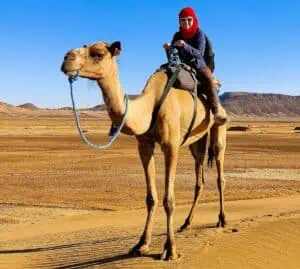
Personally, I always love booking a trip to Agafay. It’s a great way to get away from the city, enjoy the desert scenery, and spend an evening under the stars.
You can also take a day trip from Marrakech to Essaouira, a magical coastal city known for its historic Medina, ocean views, seafood restaurants, and laid-back atmosphere.
I live here, so I’m admittedly biased, but it’s one of my favorite places in Morocco!
Essaouira is easy to reach by bus or organized excursion, and you can see the main sights on a day trip. However, if you have the time, I’d recommend spending at least one night so you can enjoy the city without rushing.
My tip: If you want something extra special, book an overnight stay at a luxury desert camp in Agafay. Alternatively, rent a car and take a road trip through Morocco if you have more time.
There are so many incredible places to explore beyond Marrakech, and you don’t want to miss them!
20. Don’t Visit Bacha Coffee Without Preparing for the Crowds

Bacha Coffee is beautiful, and I genuinely like it. The coffee is lovely, the setting is gorgeous, and I used to go there all the time. But these days, overtourism has kind of killed the experience for me.
The crowds are absolutely insane. I’ve seen queues of around 50 people stretching out the door about an hour before the place even opens.
And if you arrive at the wrong time, you could end up waiting more than two hours just to get a table. That’s a pretty big chunk of time to spend standing in line for coffee!
Yes, the Dar Bacha Museum is cool, but there is no way you can happily spend 2 hours there (FYI, the cafe is inside the museum).
There’s another thing to keep in mind: if you visit later in the day, they can run out of pastries. So if you’re dreaming of enjoying a coffee and almond croissant in this stunning cafe, don’t leave it until the last minute.
My tip: If you really want to visit Bacha Coffee, go early and be prepared for a wait since they do not accept reservations.
Personally, I’d skip the savory items and focus on the coffee and pastries. I like ordering a giant gold pot of coffee, which comes with fresh whipped cream and vanilla on the side, and an almond croissant.
I still think Bacha Coffee is worth experiencing if it’s high on your list, but I wouldn’t build your entire Marrakech itinerary around it.
There are plenty of other places to enjoy a good coffee without the crowds—and sometimes, a little less hype makes for a much better experience.
21. Don’t Visit Jardin Majorelle Without a Reservation

I’ve visited Jardin Majorelle a couple of times, and I’m going to give you my HONEST opinion about this famous Marrakech attraction.
The first time I visited was in January 2023. I went right when the gardens opened, and there was hardly anyone there. I could wander around freely, take tons of stunning photos, and actually enjoy the peaceful atmosphere.
Fast-forward to February 2025, and the experience was a lot less enjoyable.
First of all, you MUST book your ticket online in advance. Don’t assume you can simply show up and buy one at the entrance.
I saw a couple leave because they hadn’t booked ahead and couldn’t get in. I’d recommend checking the official website and booking well in advance, especially during busy travel periods.
Secondly, the gardens were absolutely packed. It felt like being part of a herd of cattle, shuffling along with everyone else rather than freely exploring the complex.
At one point, I tried to walk over to a fountain to take a photo, but a staff member stopped me and told me I had to follow a specific route through the garden.
I understand why they manage visitor flow, but it was still frustrating when I remembered how freely I’d been able to explore on my first visit.
You also had to queue to take photos at some of the popular photo spots. If you’re imagining a peaceful stroll through those iconic blue buildings and lush gardens, be prepared for a rather different experience.
I also found the Berber Museum underwhelming. Personally, I think there are much better museums to visit in Marrakech.
My partner absolutely loved Jardin Majorelle, so clearly not everyone will agree with me. But I couldn’t help feeling disappointed by how much the experience had changed between my two visits.
My tip: If Jardin Majorelle is on your bucket list, book ahead and try to get an early time slot. Just manage your expectations about the crowds.
Personally, I’d consider visiting the Musée de la Palmeraie instead. I found it to be a beautiful garden and contemporary art museum where you can actually enjoy the surroundings without fighting through crowds.
When I visited, admission was just 50 MAD per person, although you should check the current price before going.
Jardin Majorelle is undeniably beautiful, but I don’t think it’s the only place in Marrakech where you can enjoy a gorgeous garden. And depending on what kind of experience you’re looking for, there may be better options.
22. Skip the Marrakech Museum (Unless You’re There for the Architecture)

I always try to visit places with an open mind, but honestly, the Marrakech Museum was a bit of a dud for me.
To be fair, the building itself is beautiful. This former 19th-century palace has stunning Moroccan architecture, intricate decorative details, and an impressive central courtyard. If you love historic buildings, you might enjoy wandering through the interior.
However, I found the collection of art and artifacts on display pretty underwhelming. The artwork I saw wasn’t particularly impressive, and the ceramics collection was just okay.
For the price of admission, I expected a much larger collection with more interesting and significant artifacts.
Personally, I think the main reason to visit is to admire the building rather than the museum exhibits themselves.
If you’re interested in Moroccan architecture and history, I’d recommend visiting Ben Youssef Madrasa instead.
It’s right next door, and I found it much more impressive. The intricate tilework, carved stucco, and beautiful courtyard make it one of my favorite architectural sights in Marrakech.
At the time of my visit, admission was just 50 MAD, although you should check the current price before going.
My tip: If you’re short on time, I’d prioritize Ben Youssef Madrasa over the Marrakech Museum.
You can always stop for a mint tea at the lovely café just outside the museum and admire the area without paying admission to see a collection that might disappoint you.
Of course, museum preferences are subjective, and if you love historic palaces, you may still enjoy the building. But if you’re looking for an impressive collection of Moroccan art and artifacts, I’d spend my time elsewhere.
23. Skip Le Jardin Secret (Unless It’s High on Your List)
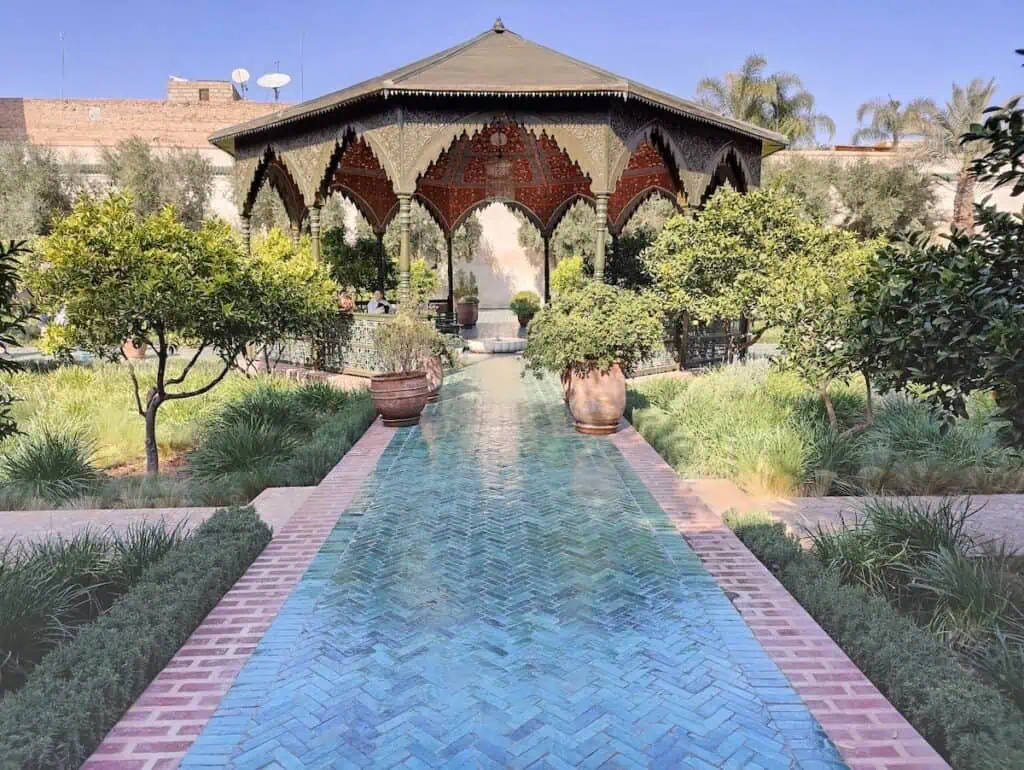
Full disclosure? I don’t hate Le Jardin Secret. It has a lovely Islamic garden, an exotic garden filled with interesting plants, and historic architecture dating back to the Saadian dynasty.
It’s a peaceful little escape from the chaos of the Medina in theory, anyway!
However, I found the garden a bit underwhelming overall. It’s relatively small, and there’s not a huge amount to see. It’s also usually PACKED with people, which makes it harder to enjoy the peaceful atmosphere you’d hope for in a garden.
And then there’s the price. Admission has increased to 100 MAD per person, which I think is pretty steep for what you get. Be sure to check the current ticket price before visiting, as prices can change.
I’d also skip the tower climb, which costs extra. Yes, the views over Marrakech are nice, but you can enjoy rooftop views across the city from plenty of cafés and restaurants without paying an additional fee.
Personally, I’d give Le Jardin Secret a pass unless you’re particularly interested in Islamic garden design or historic architecture.
I think there are better gardens to visit in Marrakech, and you can enjoy them without spending quite so much.
My tip: If you do decide to visit, try to arrive first thing in the morning, when you have a better chance of avoiding the biggest crowds. Just don’t expect a huge garden that will keep you occupied for hours.
It’s not a terrible attraction by any means, but with so many beautiful places to explore in Marrakech, I wouldn’t put it at the top of my list.
Frequently Asked Questions About What Not to Do in Marrakech
What should you avoid doing in Marrakech?
Avoid accepting unsolicited help from strangers, agreeing to taxi fares without clarifying the price, and assuming you can buy tickets for popular attractions like Jardin Majorelle on arrival.
It’s also wise to carry cash, respect local customs, and check prices before ordering food at tourist-heavy spots.
What are the biggest tourist traps in Marrakech?
Some experiences can be frustrating if you arrive unprepared, including overpriced taxi rides, unsolicited guiding in the Medina, and popular attractions that are extremely crowded.
Jemaa el-Fna food stalls can also vary in quality and transparency, so check prices before ordering. Not every vendor or attraction is a tourist trap, but a little preparation goes a long way.
Is it safe to walk around Marrakech at night?
Many visitors walk around Marrakech at night without problems, especially in busy areas such as Jemaa el-Fna.
However, some Medina alleys become quiet, dark, and confusing after shops close. Stick to well-lit streets, know how to get back to your accommodation, and avoid following strangers offering shortcuts.
What should female travelers avoid wearing in Marrakech?
You don’t need to dress head to toe in conservative clothing, particularly in tourist areas. However, clothing that covers your shoulders and knees is a useful choice when visiting religious or more conservative places.
Very revealing outfits may attract unwanted attention, so use your judgment based on the setting.
Is it rude to haggle in Marrakech?
No! Haggling is a normal part of shopping in many souks, and vendors often expect some negotiation.
Start with a reasonable offer, stay friendly, and agree on a price you’re comfortable paying. Haggling generally isn’t appropriate in supermarkets, restaurants, or shops with fixed prices.
What should you not miss when visiting Marrakech?
While this article focuses on mistakes to avoid, don’t let the warnings put you off exploring. Marrakech has incredible palaces, gardens, souks, food, and traditional riads.
Beyond the main sights, consider visiting another Moroccan city or taking a day trip to Essaouira or the Atlas Mountains. With a little planning, you can enjoy the city without getting caught up in the common tourist frustrations.
Conclusion
Marrakech is an incredible city, and despite everything I’ve mentioned in this article, I think it’s absolutely worth visiting. I’ve been living in Morocco since 2023, and there’s a reason Marrakech continues to attract visitors from around the world.
That said, knowing what to expect can make a huge difference. From navigating the Medina and negotiating taxi fares to booking popular attractions in advance, a little preparation can save you money, time, and frustration.
And don’t let the tourist traps put you off getting out there and exploring! Some of my favorite experiences in Morocco have come from wandering around, trying new food, discovering beautiful riads, and venturing beyond the usual tourist hotspots.
My biggest piece of advice? Keep an open mind, be respectful of local customs, and don’t feel pressured into spending money on something that doesn’t interest you.
You don’t have to visit every famous attraction or buy every souvenir to have an amazing trip.
And if you have time, venture beyond Marrakech. Morocco has so many wonderful places to explore, from the laid-back coastal town of Essaouira to the dramatic landscapes of the Sahara Desert.
With a little common sense and realistic expectations, you can avoid the most common mistakes and enjoy everything that makes Marrakech special. Happy travels!
If you enjoyed this guide, join our Facebook group and email list for even more awesome travel advice.
Finally, please consider buying me a coffee. It’s a great way to say “thank you” for all the free content you receive. No amount is too small and anything you can give will be greatly appreciated.

https://www.newsendip.com/morocco-hotel-room-couple-marriage-certificate/
I was able to stay with my Moroccan boyfriend at a Marriott with no issues
Lucky you. Every hotel we have tried to stay at asks for a marraige certificate and we just had to book two hotel rooms for the airport hotel in Casablanca which is why I have not changed the article. I have never been able to stay with my boyfriend in a hotel in Morocco and he is also a resident of the US.