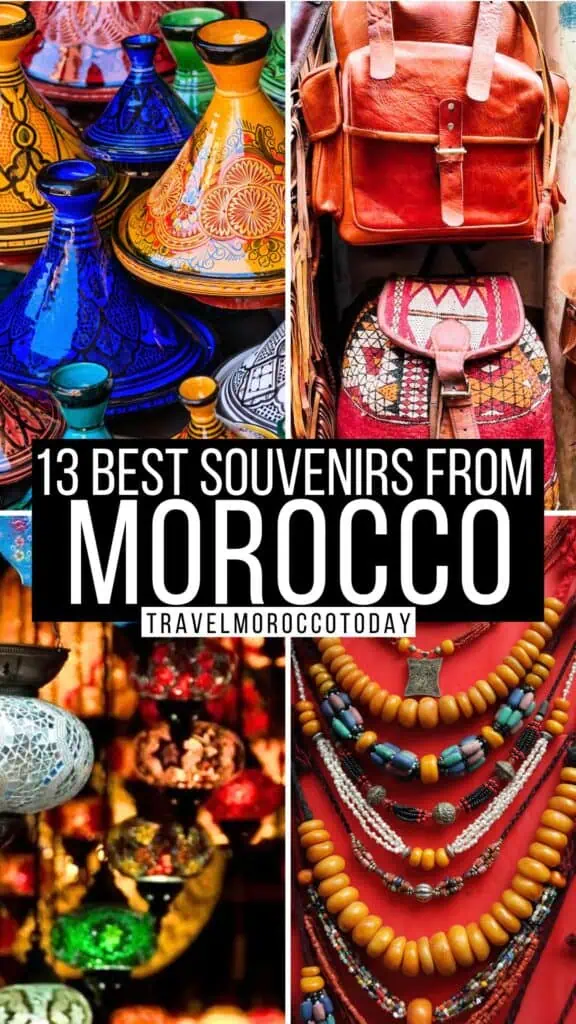
You’ll obviously want to take home some of the best souvenirs from Morocco after your trip. I know I love going shopping whenever I travel and like taking cool things home with me to remind me of my trip.
But, the question that you’re probably asking yourself right now is, “What to buy in Morocco?” This is a great question since Morocco is known for certain things and you will want to take them home with you.
However, when you are visiting a country for the first time, it can be difficult to figure out which items are the best Moroccan souvenirs of all time.
I mean, you can get a keychain that says “I love Morocco” anywhere. But, Argan oil is unique to Morocco and can only be found here. So, that is something you may want to purchase during your trip.
Luckily for you, I have lived in Morocco, with my Moroccan partner, since January of 2023. Therefore, we know exactly what to buy and what not to buy in Morocco.
In this post, I am gonna tell you EVERYTHING you need to know about the top souvenirs from Morocco. This way, you’ll understand exactly what to buy, where to buy it, and AROUND how much to pay for it.
Yeah, I know pricing can be challenging since many vendors see foreigners and immediately charge them twice as much. This happens because tourists are unfamiliar with the actual cost of local souvenirs.
Not to worry though because this epic guide will go over all of that and more. This way you’ll be prepared to shop til you drop as you make your way through the best souks in Marrakech.
Just remember to bring cash (many vendors do not accept credit cards) and don’t forget to haggle since this is the best way to get the best price while shopping in Morocco.
I like to start at 50% of the asking price and then go up from there. This way I give myself a lot of room to negotiate.
This post may contain affiliate links. Please see my disclosure for more information. As an Amazon Associate, I earn a small commission from qualifying purchases.
Table of Contents
What to Buy in Morocco: Quick List
If you’re not sure what to buy in Morocco then here is a quick list of the best Moroccan souvenirs to take home with you. These items are unique to the country and worth purchasing during your Morocco road trip or itinerary.
- Argan Oil – Found only in Morocco and great for eating and skin care.
- Leather – Purses, wallets, shoes, jackets, etc. I usually get all my leather goods in Fes.
- Berber Carpets – Unique Moroccan designs and people use traditional methods of carpet making.
- Babouche – Unique Moroccan-style shoes/slippers.
- Lanterns – These metal and glass lanterns are handmade and come with beautiful stained glass.
- Ceramics – Safi has amazing ceramics and I always like getting a fun, ceramic tajine.
- Tea/Teapots – Tea is life in Morocco so a fun teapot is a cool souvenir.
- Spices – Spices are fresh and delicious in Morocco. Some of my faves include Saffron, turmeric, cumin, and ras al hanout.
- Zellige – These are amazing traditional Moroccan tiles and you can find them everywhere.
- Moroccan Jewelry – Cool traditional items to buy include fibula (a brooch to be worn in your hair or on your dress), Khalkhal (ankle bracelet), and silver bracelets (925 silver Berber silver).
- Traditional Moroccan Clothes – Djellaba (long dress that goes down to the ground and comes with a hood), Qandrissi pants (long baggy pants that are great for the hot weather), and a Kaftan (traditional Moroccan dress).
- Pouffes – They’re like these leather footstools that you can stuff and sit on.
Best Souvenirs from Morocco
1. Argan Oil

I live in Essaouira and Essaouira/Agadir are probably the two BEST places to get Argan in Morocco. So, remember this when comparing Agadir and Marrakech.
Not only does it grow all over the place here, but you’ll get high-quality Argan at a much cheaper price (especially in smaller villages).
Plus, Argan is a super unique gift since it is only grown in southern Morocco and can be used for both cosmetic and cooking purposes.
You’ll know it’s real argan oil if it is thick, has a golden yellow color, and has a very nutty smell to it. Feel free to buy plain argan oil or soap/moisturizer that is infused with argan oil.
Generally, you can expect to pay anywhere between 50 and 150 Dirhams ($5.00 – $15.00) for 100 ml of cosmetic argan while Argan oil for cooking is a bit more expensive. It will probably cost you 200+ Dirhams ($20.00+) for a half-liter bottle.
Local Tip: Another great souvenir for anyone who loves Moroccan food (and food in general is olive oil. The olive oil here is amazing, of super high quality, is very cheap (like 45 Dirhams per half a liter), and is some of the best I’ve ever had.
I usually get mine when I go shopping in Essaouira at a local grocery store. Amlou is another great souvenir since it is made with peanuts or almonds. The nuts are ground into a fine paste that is sweetened with honey and thinned with argan oil.
2. Leather
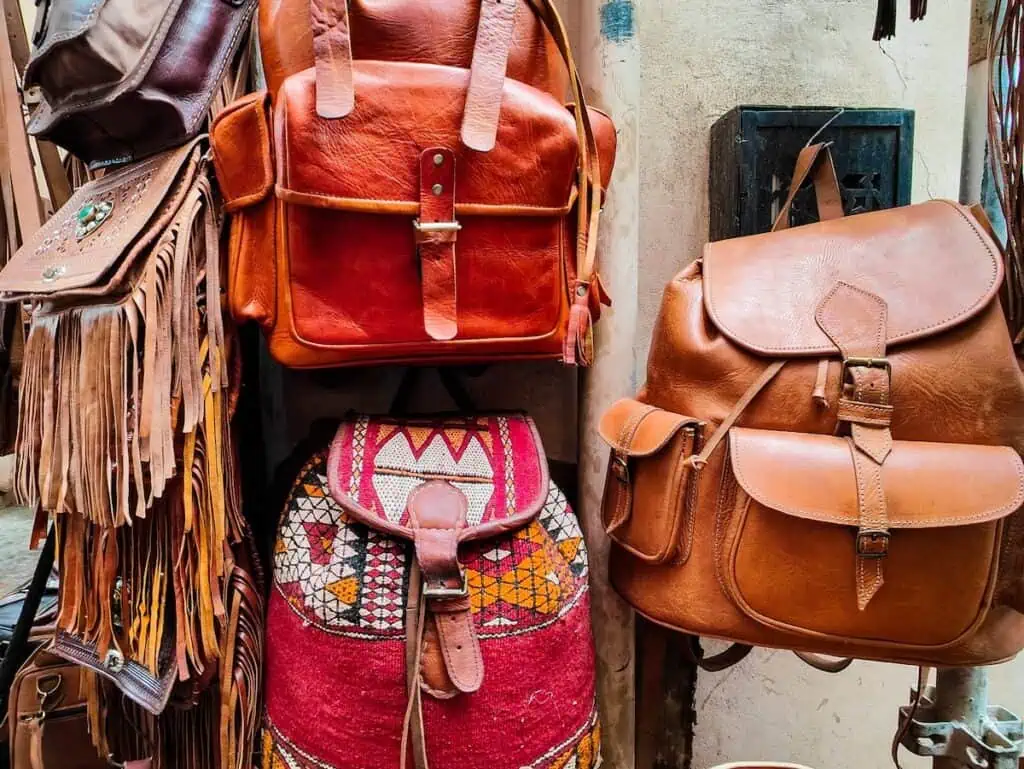
Leather is a big deal in Morocco since local tanneries still use traditional methods to create belts, shoes, backpacks, wallets, jackets, and pouffes.
Generally, I like to get all of my leather goods in Fes since the Chouara Tannery has been producing homemade leather since the beginning of the ninth century. However, Marrakech and Rissani are also great places to buy leather goods.
Just remember that leather goods are not only made with cowhides. Instead, the skin of camels, sheep, and goats is used to create an array of amazing products in Morocco.
In terms of price, it’s difficult to give an estimate since it depends on factors like the quality of the leather, the craftsmanship, and the type of item you are buying.
So, for example, a leather wallet will be MUCH cheaper than a giant leather jacket.
However, leather slippers can cost around 90 Dirhams ($9.00), medium-sized bags will cost around 550 Dirhams ($55.00), and jackets can cost between 1200 Dirhams and 2500 Dirhams ($120.00 and $250.00).
Remember, prices vary greatly. So, this is a VERY rough guide to the price of leather goods in Morocco.
3. Berber Carpets

Another must-have souvenir in Morocco is an amazing, handmade, Moroccan rug. These rugs are stunning and come in a wide variety of styles.
Therefore, you should have no problem finding an amazing rug that suits your particular style and budget. I know it’s a bit of a splurge but anything you get here is still way cheaper than what you’ll find in the US and Europe.
If you can, wait to buy one until the end of your trip. This way you can figure out exactly what you want and have time to sharpen those haggling skills.
Yeah, these rugs are not cheap. So, buying one can be a bit of a process as you shop, drink tea, and negotiate the price with the store owner. Prices can also vary wildly based on location, size, quality, design, shape, and the age of the rug.
However, if something doesn’t feel right then do not hesitate to walk away. There are rug stores all over Morocco and you will be able to find the perfect carpet for you.
If you do see a carpet or pattern that you love, remember that it can take a couple of weeks to complete the rug. So, don’t be surprised if you have to wait for the rug you want.
Local Tip: Please note that Berber carpets/rugs are NOT cheap. You can spend anywhere between a few hundred and a few thousand dollars for a high-quality, homemade rug.
It is an investment and you should be mentally prepared for that. I know I wasn’t when I went shopping during my 3-day desert tour from Marrakech to Fes.
Generally, the types of rugs made in Morocco vary from region to region. Ask about the specific type of rug made where you are shopping and you should be able to get a good price since the rug is indigenous to that area.
Lastly, haggle your butt off for the best price possible. There is also nothing wrong with walking away if you do not get the price you want. You could also travel with a Morocco tour company and have them handle the bargaining.
And if your kids get bored, just take them to enjoy some of the best things to do in Marrakech with kids instead.
Planning 7 Days in Morocco? Start Here.
Skip the hours of research and guesswork. I created this 45-page, step-by-step Morocco itinerary based on my years of living and traveling in Morocco. It lays out where to go, what to see, and how to make the most of a 7-day trip, without spending weeks planning it yourself. Get the practical itinerary I wish every first-time Morocco traveler had.
4. Babouche (Moroccan Slippers)

Commonly referred to as Balgha, aka Babouche, these charming Moroccan slippers are as unique as they are beautiful!
These pointy-toed shoes are backless and you can find them all over Morocco. I typically buy mine in Marrakech (for convenience’s sake) but the best place to get them is in Tafraoute since this is what the town is known for.
Both men and women wear these shoes and you can find a great pair at the Souk Principal des Babouches, aka Souk Smata, in Marrakech.
This market is brimming over with traditional slippers in every color imaginable! Just remember that prices can vary based on the sole’s thickness, how many layers it has, the quality of the shoe, and the exterior decorations.
However, most pairs start at 60 Dirhams ($6.00). Just know that the price can increase significantly if you buy a better-quality shoe.
It’s also worth noting that while you might hear them referred to as Babouche, that is also the Moroccan word for snail. After all, my partner is Moroccan and swears that they are called Balgha.
So, if locals look confused then try to say “Balgha” instead of “Babouche” and see what happens.
5. Lanterns

A hand-crafted lantern is an awesome souvenir from Morocco. After all, every time you look at it it instantly takes you back to the vibrant, fast-paced souks of Morocco.
Now, you’ll find plenty of lanterns that vary when it comes to size, weight, and the materials used to create the lamp.
You can find lighter lanterns that are a bit cheaper. But, they are often made out of aluminum and aren’t nearly as durable as pricier lanterns crafted out of metal.
So, these lightweight aluminum lanterns may get a bit bent and misshaped if you just toss them in your suitcase and bring them home with you.
These low-quality lanterns also tend to rust and lose their color within a short period of time.
Therefore, if I was buying a Moroccan lantern then I would go for a high-quality lantern made out of glass and metal. They are much more durable and are much less likely to lose their shape and color over time.
You also may want to ask about wiring if you plan to connect the lamp to an outlet once you get back home. Yeah, the plugs in Morocco are probably very different from the ones you use in your hometown.
In terms of where to get these lanterns, I would buy them at any shop that specializes in metalwork.
After all, they are pretty common throughout the country and you will probably pay between 150 Dirhams and 550 Dirhams ($15.00 and $55.00) for a cheaper aluminum one.
In contrast, a good metal one will probably start at 350 Dirhams ($35.00) and can cost up to 2000 Dirhams ($200.00) if it is a larger one.
Just shop around and wait to get one until the end of your trip. This way you don’t have to carry the lantern around with you as you visit some of the most beautiful places in Morocco.
You can also pay extra to have some of the bigger lanterns shipped home for you after visiting Marrakech in January.
Want to Feel Confident Traveling in Morocco?
Get the practical safety advice I wish every first-time visitor had before their trip. I’ve lived in Morocco since 2023 and have spent years traveling around the country. I created this 26-page Morocco Safety Guide to give you practical, realistic advice for navigating Morocco confidently—from avoiding common tourist scams to knowing what to expect and how to handle situations that can catch first-time visitors off guard. No fear-mongering. No generic advice from someone who spent a week in Marrakech. Just practical tips from someone who actually lives here.
6. Ceramics

Handmade pottery is EVERYWHERE. But, the absolute best place to get ceramics in Morocco is Safi, closely followed by Fes and Meknes.
Safi is a coastal city that is about four hours away from Casablanca and about two hours away from Essaouira, making it an epic day trip from Essaouira if you want to do some shopping.
The ceramics here are cheap, of super high quality, and include cups, bowls, plates, vases, tajines, and more. They also come in a wide array of colors that include neutral tones as well as more vibrant hues.
If you have time, definitely see the largest tajine in the world and visit the National Ceramics Museum since both places are awesome.
Alternatively, just head to a local ceramics shop in the city of your choice. You can visit a wholesale store (buy in bulk to get the best deals) or a small local shop if you want to purchase one or two things.
Generally, items start at 20 Dirhams ($2.00) and can cost up to 300 Dirhams ($30.00) if you want a bigger piece.
I would get a tajine since it is VERY Moroccan. I use a plain one for cooking and it cost me 25 Dirhams ($2.50). But, it is very NOT fancy and is just for the kitchen.
You can try to get more decorative tajine for 100+ Dirhams ($10.00+) if you want to display one in your home.
Also, feel free to ask about additional colors if you don’t see what you like. You can even have your items wrapped or see if they can ship them to avoid damage when you fly home.
7. Tea/Teapots

Tea is LIFE in Morocco. So, a great Moroccan souvenir is a silver teapot or some fresh tea. In terms of tea, I usually buy the “Lion” brand from the grocery store.
It has a giant lion on it, hence the name. It’s a dried, pre-packaged tea that I add fresh mint to once I get home.
Now, if you want fresh mint in Morocco then Marrakech is the place to go. The city is renowned for having some of the best mint in the country.
Just look up local customs laws before you bring anything home with you since you don’t want your mint to get confiscated at the airport.
In terms of teapots, you can get them from pretty much any metal shop in Morocco. Everyone drinks tea so tea pots are widely available throughout the country.
If you want a really high-quality teapot then you can watch the artist at work and see them do some hand etching into the teapot.
Typically, they are made out of brass, copper, or silver. However, the materials used vary based on the quality of the teapot.
For an epic handmade teapot, head to Fez or Sefrou and expect to pay anywhere between 150 Dirhams and 300 Dirhams ($15.00 and $30.00).
8. Spices
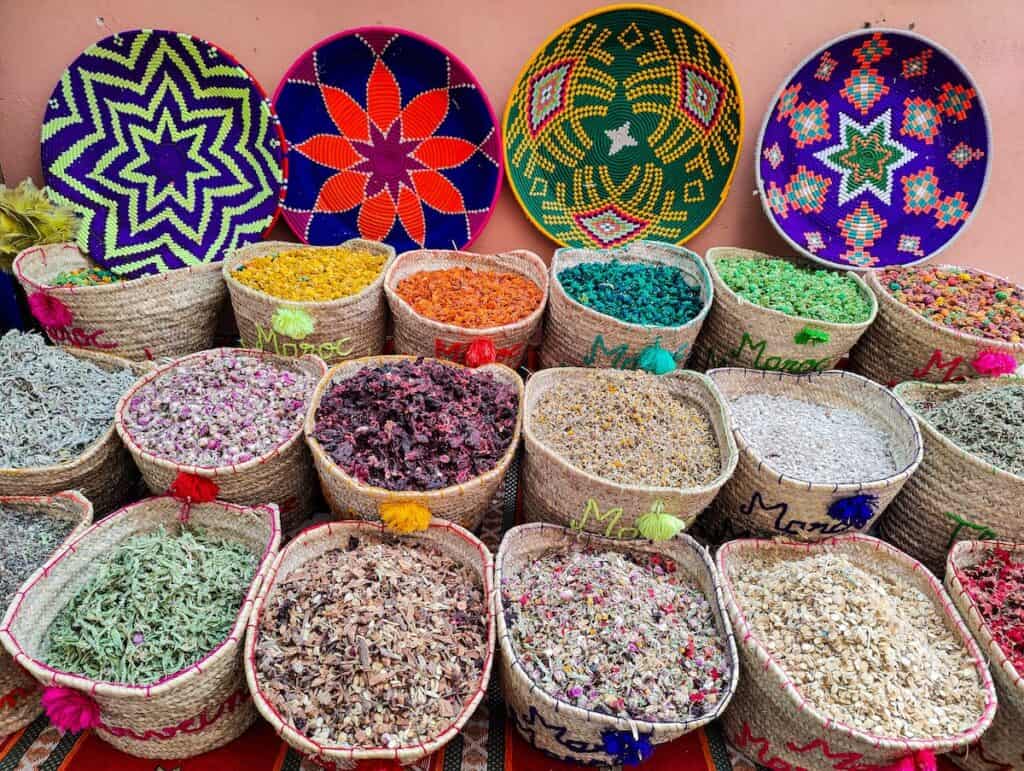
When it comes to spices and food in general, the flavor and quality is much better in Morocco than in Europe or the US. Everything here is just a lot fresher and tastes WAY better IMHO.
Therefore, I would stock up on amazing dried fruits and spices while you’re here. Added bonus? Spices and dried dates are much cheaper than anything you’ll find at home.
Typically, it’s 50 – 70 Dirhams ($5.00-$7.00) for a gram of saffron, 20 Dirhams ($2.00) for paprika/cumin/turmeric, 10 Dirhams ($1.00) for dried mint, 15 Dirhams ($1.50) for pepper/cinnamon/ginger, and 30 Dirhams ($3.00) for Ras al Hanout.
They are also easy to pack and can generally go through customs as long as they are dried.
So, stop by a local shop (hanout) selling dried goods and ask them to freshly grind things like cinnamon, paprika, cumin, saffron, turmeric, and ras al hanout for you.
If you can, try to visit a hanout that is frequented by locals. The shops with hordes of tourists are basically giant tourist traps and can be very overpriced.
You should also buy ONLY what you think you are actually going to use. Otherwise, it’s kind of a waste if you buy all these cool spices and then never actually use them.
Other items you can pick up include dried dates (get the darker, sweeter ones), almonds (best in the North), figs, and olives (another classic in Morocco).
Local Tip: Wait until you leave to get spices. This way they will be as fresh as possible when you get home. I would also get saffron in Tailouine and dates in November/December when they are harvested.
9. Zellige

Zellige is a style of mosaic tilework that you will find in traditional Moroccan architecture, especially in luxurious riads in Marrakech. Generally, the individual tiles are hand-chiseled and put together to create AMAZING geometric patterns.
In fact, artisans usually have to apprentice for over ten years before they are considered master craftsmen.
It’s a very unique form of art since the artists need to memorize the designs and then create them upside down. So, one small mistake and the entire mosaic is ruined.
But, Zellige is next-level gorgeous and you will find individual tiles for sale all over Morocco. You can buy some tiles and then use them to create amazing patterns back at home.
For the best tiles possible, head to Tetouan or Fes. I am not going to give you a price since it varies based on the quality of the tile and the intricacy of the patterns. But, more basic designs will cost at least a few hundred Dirhams.
10. Moroccan Jewelry

I’m kind of obsessed with shopping for jewelry in Morocco! The pieces are lovely and an epic mix of silver and bronze. They also feature these incredible geometric and floral designs that are unlike anything I’ve ever seen.
During your travels, keep an eye out for a fibula, which is a stylish brooch that you can wear in your hair or on your dress. You can also get a Khalkhal (a super cute ankle bracelet) or a bracelet made with 925 silver or Berber silver.
If you like unique Moroccan designs then get something with a Khamsa on it. It’s an upside-down hand that is meant to ward off evil and protect you from the evil eye.
Just be super careful when shopping for jewelry in Morocco (Especially in Marrakech. One of my many Marrakech tips) since a lot of it is fake and not made with real silver.
If you want the real deal though, head to Essaouira since this town is known for its silver. You’ll probably pay around 500 Dirhams ($50.00) for a GOOD quality piece, depending on it’s size and intricacy.
Just always double-check and make sure it’s real before you buy anything. Yeah, there is a TON of fake silver out there.
Planning a Trip to Morocco? Let Me Help You Get It Right.
Not sure where to go, how long to stay, or how to put everything together? Book a private one-on-one Morocco travel consultation with me, and let’s figure it out together. I’ve lived in Morocco since 2023 and have spent years exploring the country. I’ll help you create or refine an itinerary based on your interests, travel style, timeframe, and budget—rather than giving you a generic itinerary that may not actually suit you. Already have an itinerary? That’s okay too. We can go through it together, and I’ll help you identify what works, what doesn’t, and where you can make improvements.
Stop second-guessing your Morocco trip. Let’s make a plan.
11. Moroccan Clothes

When it comes to shopping for Moroccan clothes, ALWAYS check the quality before you buy anything.
Some items may look great but can be stained, ripped, and of very poor quality. Therefore, always do a little quality control check before you buy anything, and do not be afraid to say “no thank you” and walk away.
Vendors can be pushy, but stand your ground and do not buy anything that you don’t want. Other than that, just enjoy shopping for some ultra-rad traditional clothes.
Highlights include djellabas (informal long tunic dresses that may come with a hood), Babouches (Moroccan slippers), airy Qandrissi pants (long bangy pants), and stylish Kaftans (traditional dresses for weddings).
While you can find these traditional clothes anywhere and everywhere in Morocco, some of my fave places to shop in Marrakech include Akbar Delights, Au Fil d’Or for luxurious kaftans, Karim Bouriad, Max & Jan, Laly, and Topolina.
I like these stores because they have an awesome mix of traditional/fusion modern styles that are extremely wearable.
Local Tip: Some Moroccan clothes look really awesome here and you feel like you HAVE to get them. Then, when you get back home, you never wear them because you feel really out of place.
This happened to me with a pair of Alpaca leg warmers in Peru. So, I know the struggle when it comes to what to buy in Morocco. Therefore, always make sure you’ll actually wear that Kaftan back at home BEFORE you buy it.
Alternatively, head to local malls/more modern neighborhoods and try to get more modern versions of traditional clothes. I know I got a Souk Wear sweatshirt and wear it all the time since it is a bit more Western in style.
12. Pouffes

You can’t walk through the souks of Morocco without seeing pouffes everywhere! They are basically like these round, leather footstools, cushions, seats, or tables that come in a wide variety of designs and colors.
When you see them, they usually look like these round, flat circles since they are sold unstuffed. You then buy one, take it home, and fill it up with polyester stuffing, old clothes, or anything you want really.
Personally, I like to go shopping in Marrakech at Chay Abdelhadi’s leather pouf workshop. But, you can find them all over Morocco. Basically, anywhere they sell Moroccan souvenirs you can find one.
However, Fes is another great place to get one since they make the leather out of camel/goat skin and then hand-dye the pouffe.
You can expect to pay around 100 Dirhams ($10.00) for a low-quality pouffe or 250 Dirhams ($25.00) for a nicer one.
13. Musical Instruments/Gnawa Music

I live in Essaouira and Gnawa music is HUGE here. It has a very unique sound that is super traditional and that features a lot of chanting as well as the use of instruments like symbols, drums, and the gimbri (kind of like a guitar).
Personally, I wouldn’t pick up a full-on instrument while I was here. But, I would get some cool Gnawa music to take home with me. Or, just go to a local concert and listen to it live since it is unlike anything I’ve ever heard.
Trust me, going to a Gnawa concert is easily one of the coolest things to do in Essaouira, especially if you’re looking for things to do in Essaouira at night.
If you REALLY want to take an instrument home with you then you’ll have to choose between more Arabic and more indigenous-style instruments.
Iconic Moroccan instruments include the oud (an Arabic guitar), the Bendir (wood drum), the Rabab (like a lute), Krakeb (hand symbols), and more.
Prices vary dramatically but you could pay 10 Dirhams ($1.00) for small symbols and 100 Dirhams ($10.00) for a drum. I would also try to get them in Essaouira since this place is like the unofficial home of Gnawa.
Conclusion
That wraps up this local’s guide to the best souvenirs from Morocco. I hope you now know what to buy in Morocco and are a bit less stressed out about shopping here.
No matter what you buy, always remember to have cash handy and be sure to haggle, haggle, haggle. This way you can get the best price possible.
I would also shop around and compare prices before buying anything. This way you’ll have a rough idea of how much something SHOULD cost and are less likely to get overcharged just because you’re a tourist.
Personally, I would add things like olive oil, fresh spices, a teapot, a tajine, a Berber rug, dates, Argan oil, Babouches, and leather goods to my Morocco shopping list.
These items are awesome, usually easy to pack, and are basically what Morocco is famous for. If you enjoyed this post, be sure to join our email list and Facebook group for even more awesome Morocco travel advice.